
HISTORY · DISH ORIGINS
Burnt Ends History: How Brisket Scraps Became a Kansas City Specialty
Kansas City's burnt ends began as irregular smoked-brisket trimmings. Arthur Bryant's free counter scraps became famous, and restaurants changed how they made them when demand outgrew the supply.
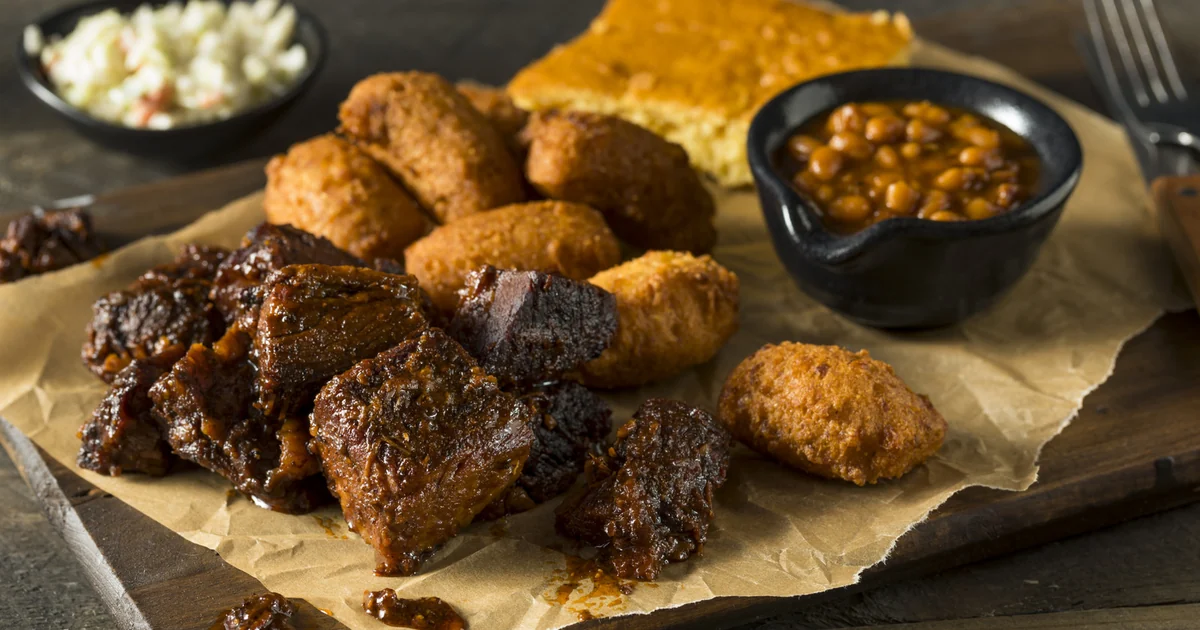
What the original burnt ends were
The early pieces were the dark edges and fatty corners cut off a smoked brisket. Bonjwing Lee's 2014 Eater report describes them as crisped bark that cooks had traditionally set aside for themselves. At Arthur Bryant's, customers could help themselves to the trimmings pushed aside on the counter.[1][2]
A trimming is not a standard portion. Its shape depends on the brisket being sliced, and a single brisket yields only so many edges. The original description does not identify every piece as point or flat. Those names refer to the brisket's two muscles; they do not tell us which muscle supplied each historical scrap.[1][2]
Arthur Bryant's and the essay that made them famous
Bryant's belonged to a longer Kansas City barbecue lineage. Lee traces the business from Henry Perry to Charlie Bryant, who took over in 1940, and then to Charlie's brother Arthur. Arthur's counter is the place Calvin Trillin celebrated, not evidence that nobody else had served brisket edges.[1]
Trillin's essay, titled No!, appeared in Playboy's April 1972 issue. Quotations of the original describe the free brisket edges. That makes 1972 the date of this piece, not 1974 and not the year someone invented burnt ends.[2]
Trillin wrote: "I dream of those burned edges." He described the counterman moving the pieces aside for customers to help themselves. His extravagant praise of the restaurant brought national attention to something its regular customers already knew.[2][1]
The same passage complicates the invention story. Trillin also described Snead's selling brisket edges with more meat attached as brownies, alongside ham brownies. Arthur Bryant's helped make the dish famous, but this account does not establish a sole inventor or a first sale.[2]
What changed as demand grew
The chapter description for Kansas City PBS's Burnt Legend gives the problem plainly: Trillin created demand, Bryant's put burnt ends on the menu, and supply could not keep up. Lee's Eater report describes the same commercial pressure. Restaurants needed a way to make more than the incidental scraps from slicing brisket.[3][1]
Many began producing burnt ends from the fattier point muscle. Lee describes restaurants cooking the point separately or returning it to the smoker after cooking the whole brisket, then chopping it into pieces. The leaner flat could still supply sliced brisket. This made burnt ends a dish a restaurant could plan to serve, rather than a small by-product of another order.[1]
That was not the only method. Lee also found restaurants using flat meat or cubing an entire brisket. In his 2014 tour, Gates and LC's still served the crisp corner pieces he associated with the older style. The two approaches coexisted; the cubes did not replace every trimming-based serving overnight.[1]
Original, modern, and pork belly compared
| Version | Difference |
|---|---|
| Original | Irregular dark edges and fatty corners from slicing smoked brisket. At Bryant's, customers helped themselves. [2] |
| Brisket cubes | Chunks or cubes produced deliberately, commonly from point, though methods vary by restaurant. [1] |
| Pork belly | A pork variation that borrows the brisket dish's name and the idea of rich, smoked cubes. [4] |
Why pork belly borrows the name
Pork belly is a different cut from a different animal. KMUW's Cooking with Fire feature presents it as a new-fashioned version of the brisket dish: cooks applied the idea of fatty, smoked cubes to pork belly, then added a sauce finish. It is a variation on the beef trimmings Trillin described.[4]
For the cooking method rather than the origin story, use the pork belly burnt ends guide. The history of brisket in Texas follows a separate path from meat-market cut to signature dish.
Kansas City's broader place in American barbecue is covered in the regional barbecue overview. The sauce on a plate of burnt ends has its own story, including the spread of sweet tomato bottles, in the history of barbecue sauce.
Where this history comes from
Trillin's wording comes from the linked articles that quote his essay. The PBS citation supports its written chapter description. This article does not claim a reading of the original magazine or a viewing of the documentary.
Common questions about burnt ends history
What are burnt ends made from?
The Kansas City dish started with dark, fatty trimmings from smoked beef brisket. Modern restaurant versions are often deliberately made chunks or cubes of brisket point, though some restaurants use flat meat or whole briskets. Pork belly burnt ends are a separate pork variation.
Did Arthur Bryant's invent burnt ends?
The sources establish Arthur Bryant's role in making them famous, not a sole invention. Calvin Trillin described free brisket edges there in April 1972, but his essay also described Snead's selling similar pieces as brownies.
Are burnt ends always cut from the point?
No. Point is a common source for the purpose-made modern dish. Trillin described burned brisket edges without identifying a muscle, and later restaurant methods include point, flat, and whole-brisket cubes.
Why are pork belly burnt ends called burnt ends?
They borrow the name and the idea of rich, smoked cubes from the brisket dish. Pork belly is not the beef brisket served at the Kansas City counters in the original accounts.
Related guides
How Brisket Became Barbecue's Centerpiece
Brisket was a cheap, tough cut that long cooking redeemed. How Jewish home cooks and Central Texas butcher shops made it an icon.
Read the guidePork Belly Burnt Ends: Temp and Timing Guide
Pork belly burnt ends are done around 200°F, jiggly and tender rather than firm. Smoke at 225 to 250°F, cube, then glaze for a final caramelized finish.
Read the guideWhy Barbecue Is Different in Every Region
Carolina whole hog, Memphis ribs, Kansas City everything, Texas brisket. Each regional style is a record of who settled there and what meat cost.
Read the guideThe History of BBQ Sauce: Vinegar, Mustard, Tomato, and Alabama White
BBQ sauce history follows vinegar bastes, tomato dips, disputed South Carolina mustard origins, Alabama white sauce, and the rise of sweet bottled sauces.
Read the guide