
HISTORY · ONE CUT
How Brisket Became Barbecue's Centerpiece
Brisket began as an inexpensive, tough cut that rewarded long cooking. European Jewish kitchens braised it for holidays, while Central Texas meat markets smoked it. Those traditions helped turn a discount cut into a barbecue destination.
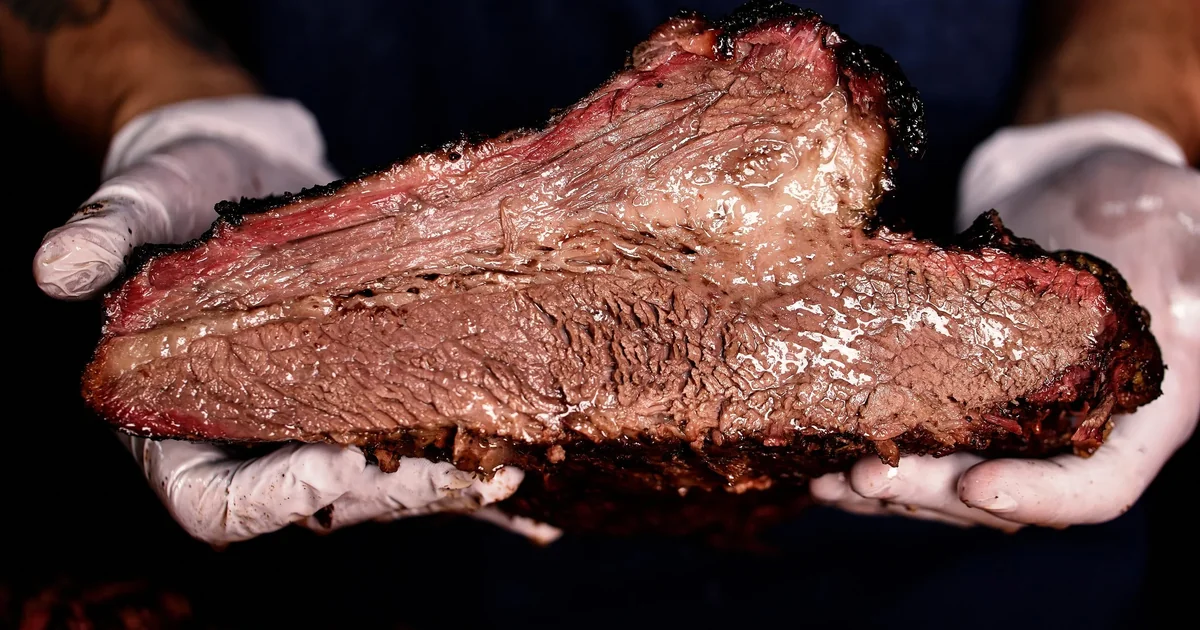
First, why brisket is tough
The brisket is the chest muscle that supports roughly half a standing steer's weight with every step. A muscle that works that hard is laced through with collagen and connective tissue, which makes it rubbery at normal cooking temperatures. It only becomes tender as collagen gradually converts to gelatin over a long cook, a process that takes both time and heat, so brisket traditions repeatedly arrived at the same practical answer: cook it much longer than seems reasonable. That chemistry is explained fully in the brisket internal temp guide.
The kitchen tradition: braised, glazed, holiday table
European Jews made brisket a holiday staple for practical reasons. Brisket was an affordable cut that suited long cooking, and slow-braised brisket became a centerpiece of Ashkenazi holiday tables in America. When Jewish delicatessens spread through American cities in the early 20th century, brisket came with them as comfort food rather than barbecue.
The pit tradition: German butcher shops in Central Texas
Meanwhile, German and Czech immigrants settling Central Texas in the mid-to-late 1800s opened butcher shops modeled on the ones they left behind. Before refrigeration, any unsold meat risked spoiling over the weekend, so shops smoked leftover cuts and ground trim into sausage to save the investment.
Customers bought that smoked meat by the pound, ate it off the butcher paper with crackers and pickles, and called it barbecue. Southside Market in Elgin traces to 1886, and Kreuz Market in Lockhart carries a butcher-shop lineage back to 1900.
Beef was what those shops had, and brisket was the beef they needed to move. Black pit traditions and broader Southern pork cooking supplied the technique of slow indirect fire; the Texas Historical Commission credits the merger of those streams, Southern pork craft applied to plentiful inexpensive beef, with making brisket the centerpiece. During a long cook, the fat cap protects the meat from the strongest heat while internal marbling supplies moisture.
From lunch counter to destination
For most of the 20th century, Texas brisket was working-class food: laborers bought it standing up because restaurants excluded them, and the joints that served it were pit stops between here and somewhere else. Three things changed its status:
- Interstate travel turned small-town smokehouses into destinations; Kreuz, Southside, and their peers became stops worth planning a route around.
- Food media turned national attention toward Central Texas in the 1990s and 2000s.
- A new generation of pitmasters treated brisket as craft rather than commodity, sourcing specific cattle, burning specific wood, and holding the meat properly instead of serving it whenever it finished.
Franklin and the new-traditionalist wave
The clearest marker of the shift is Franklin Barbecue, which Aaron Franklin started in an Austin trailer in 2009 and moved into a brick building in 2011. The restaurant became known for selling out of brisket, drawing lines measured in hours, and putting post oak smoked prime brisket on the national map. Franklin also earned a James Beard Award in 2015. Food writers credit him with leading what is often called the new-traditionalist movement: old methods, executed with new discipline.
Brisket anchored menus for a century because it was inexpensive. Today it is often the most expensive item per pound at the same counters because demand has changed its market value.
Kansas City took brisket in another direction: edge trimmings became a dish that restaurants learned to produce deliberately. That change is traced in the history of burnt ends.
Cooking it today
For the cook itself, buy a packer, season it, run the pit steadily, expect the stall, and leave enough time for a proper rest. The timing math lives in how long to smoke a brisket, the finish line in brisket internal temp, and the patience afterward in how long to rest a brisket. If you want the whole first cook mapped out, the Beef Brisket Command Pack is the printable version.
Where this history comes from
- Texas Historical Commission: bringing Texas barbecue history to the table
- Authentic Texas: the history of Texas barbecue, brisket and smoke
- Texas Monthly: mapping Texas barbecue history
- Southern Foodways Alliance: oral history with the Kreuz Market family
- James Beard Foundation archive: Aaron Franklin, 2015 Best Chef winner
Common questions about brisket history
Why is brisket so expensive now?
Demand. Brisket anchored menus for a century because it was a cheap cut that long cooking redeemed, but the craft barbecue boom of the 2000s and 2010s turned it into the dish people line up for. The cut did not change; its reputation did.
Did Jews invent brisket?
No single group invented it. European Jewish home cooks braised brisket for holidays because it was affordable and suited long cooking, while Central Texas butcher shops smoked beef trim before it spoiled. The two traditions are separate and both matter to how Americans eat brisket today.
When did Texas start smoking brisket?
German and Czech butcher shops were smoking leftover meat in Central Texas by the late 1800s, with Southside Market in Elgin tracing to 1886 and Kreuz Market in Lockhart to 1900. Brisket became the signature cut over the 20th century as those shops turned into barbecue restaurants.
What made Franklin Barbecue famous?
Aaron Franklin started it in an Austin trailer in 2009 with post oak smoked brisket cooked with discipline: good cattle, steady fire, and proper rest. The restaurant became known for selling out of brisket, drawing hours-long lines, and putting Central Texas brisket on the national map. Franklin also earned a James Beard Award in 2015.
Related guides
Brisket Internal Temp: When Is Brisket Done?
Brisket is done around 203°F internal in the flat, when a probe slides in like butter. Point vs flat temps, the 160°F stall, wrapping, and a 225 to 250°F pit.
Read the guideHow Long to Smoke a Brisket: Per-Pound Times That Add Up
Plan about 75 minutes per pound at 225 to 250°F: a 12 lb packer runs about 15 hours. Per-pound times, why small flats break the rule, and when to start.
Read the guideHow Long to Rest a Brisket (and How to Hold It for Hours)
Rest a brisket at least 1 hour, ideally 2. How resting works, how the cooler hold keeps a brisket at or above 140°F, and where that hold runs out.
Read the guideA Short History of Barbecue: From Barbacoa to the Pit
Barbecue comes from barabicu, a Taíno word in print by 1526. How it moved north to the pits of the colonial Southeast, and what historians still debate.
Read the guide