
HISTORY · THE PIT CREWS
The Black Pitmasters Who Built American Barbecue
Black cooks did much of the work that built American barbecue. Enslaved cooks ran pits at political feasts and plantation barbecues in the colonial South. After emancipation, freedmen turned that skill into businesses, and their descendants shaped many of the restaurants that followed. Older accounts often left their names out.
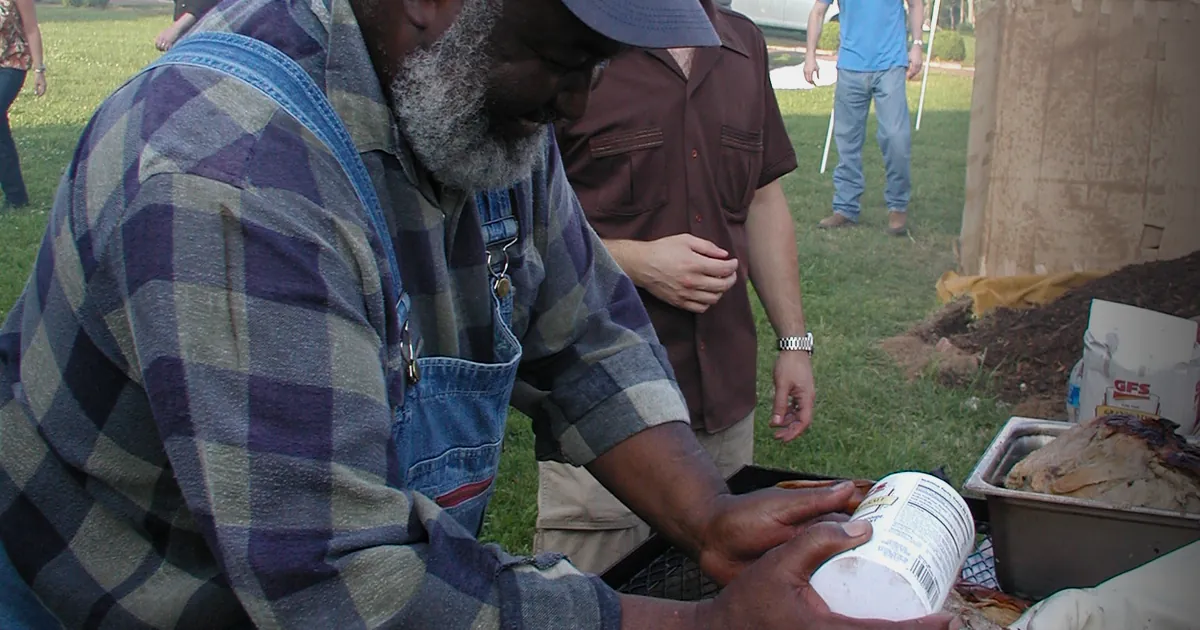
Photo by Angie Mosier for Southern Foodways Alliance (CC BY 2.0), cropped.
The pit crews of the colonial South
As the history of barbecue lays out, the cooking method that became American barbecue took shape in the colonial Southeast: coals in a trench, whole animals across them, a vinegar mop applied for hours. The people doing that work were mostly enslaved. Enslaved Black people were the principal cooks in most households of that era, and at the large public barbecues that marked elections, holidays, and muster days, the overnight pit shifts were theirs too.
This was skilled labor performed under coercion. Cooks handled dozens of hogs over shifting coals, judged doneness without thermometers, and kept trench fires alive through twelve-hour cooks for crowds they were often not welcome to join.
The consensus of the late 1800s
After emancipation, the skill became a livelihood. Adrian Miller, the James Beard award-winning historian whose book Black Smoke documents this history in detail, writes that a general consensus emerged in the late nineteenth century that Black barbecuers made the best and most authentic barbecue. White hosts hired Black pit crews for their barbecues the way they hired Black chefs for their kitchens, because they were the recognized masters of the craft.
Some of those cooks are documented by name. Old Arthur Watts, born enslaved in Randolph County, Missouri, in 1837, made sauces so prized they are still sold today. In Owensboro, Kentucky, Harry Green, born enslaved in Breckinridge County in 1855, started selling pit-cooked mutton from his home yard in the late 1880s, became the barbecuer of the Daviess County Fair, and cooked up to a thousand pounds of mutton a season at the fairgrounds for more than thirty years. Owensboro's commercial barbecue industry starts with him.
Henry Perry and the birth of Kansas City barbecue
The clearest case study is Kansas City. Henry Perry came to the city from Memphis in 1907, sold smoked meat from a stand in the Garment District, then moved to 18th and Vine, where he slow-cooked over hickory and oak and let the juices drip onto the coals. He smoked whatever the market gave him: hog, mutton, possum, raccoon. He called himself the Barbecue King in his own newspaper ads, and he was selling out daily decades before the city had any other barbecue landmark.
Two things about Perry's operation deserve emphasis. First, his restaurant drew Black and white customers eating together during the Jim Crow era, which locals described as a place where segregation ended when you walked through the door. Second, nearly every famous Kansas City barbecue lineage runs through his pits: Arthur Bryant's and Gates, the two names that define the city, were both founded by cooks who learned under Perry. He died in 1940. The style he coined is still the city's style.
Why the names faded
Several documented forces pushed Black cooks and business owners out of the popular history:
- Segregation limited where Black entrepreneurs could own restaurants, buy property, or get capital, capping how many businesses could scale.
- Newspaper coverage followed ownership, not labor, so the pits got photographed while the pit crews stayed anonymous.
- Urban renewal gutted thriving Black business districts, including barbecue rows, in mid-century American cities.
- Starting in the 1990s, television and magazine food coverage centered white pitmasters, and the default face of barbecue reset within a generation.
Miller's account is blunt about the last part: food coverage shifted along with the industry. The result is a popular image of barbecue that is younger and whiter than the tradition itself.
The correction underway
Adrian Miller's Black Smoke (2021) gave this history its first book-length treatment. Ed Mitchell of North Carolina brought his family’s whole-hog tradition to a national audience, and his son Ryan and grandson continue it. Long-running Black-owned restaurants in Memphis, Kansas City, Lexington, Kentucky, and other cities preserve some of the oldest parts of the tradition.
The low-and-slow methods used today, including pit cooking and vinegar mops, descend in part from cooks whose names rarely appeared on menus or in newspapers. Accurate barbecue history should name that contribution.
Where this history comes from
Common questions about Black pitmasters and barbecue history
Who were the first pitmasters in America?
Enslaved and, later, free Black cooks. They did most of the pit work at colonial and antebellum barbecues, and by the late 1800s a general consensus held that Black barbecuers made the best and most authentic barbecue. Documented names include Old Arthur Watts in Missouri and Harry Green in Owensboro, Kentucky.
Did Henry Perry found Kansas City barbecue?
He coined it. Perry arrived from Memphis in 1907, ran pits in the Garment District and then at 18th and Vine, and called himself the Barbecue King in his own ads. The founders of Arthur Bryant's and Gates both learned under him, so nearly every famous Kansas City lineage runs through his pits.
Why are so many Black barbecue pioneers missing from older histories?
Segregation capped how many Black-owned businesses could scale, newspapers covered owners rather than pit crews, urban renewal gutted Black business districts, and food coverage from the 1990s on centered white pitmasters. Historian Adrian Miller's book Black Smoke is the standard correction.
Is Black Smoke by Adrian Miller a good starting point?
Yes. It is the first book-length history of Black Americans and United States barbecue, published in 2021, and it documents both the tradition's origins and the mechanisms that pushed its people out of the popular story.
Related guides
A Short History of Barbecue: From Barbacoa to the Pit
Barbecue comes from barabicu, a Taíno word in print by 1526. How it moved north to the pits of the colonial Southeast, and what historians still debate.
Read the guideWhy Barbecue Is Different in Every Region
Carolina whole hog, Memphis ribs, Kansas City everything, Texas brisket. Each regional style is a record of who settled there and what meat cost.
Read the guideHow Long to Smoke a Brisket: Per-Pound Times That Add Up
Plan about 75 minutes per pound at 225 to 250°F: a 12 lb packer runs about 15 hours. Per-pound times, why small flats break the rule, and when to start.
Read the guide