
HISTORY · EQUIPMENT
From Earthen Pit to Pellet Grill: A Smoker History
Most equipment on a modern patio was invented within the last hundred years, much of it after World War II. Each design made outdoor heat easier to control, from uniform charcoal to digital pellet feeders.
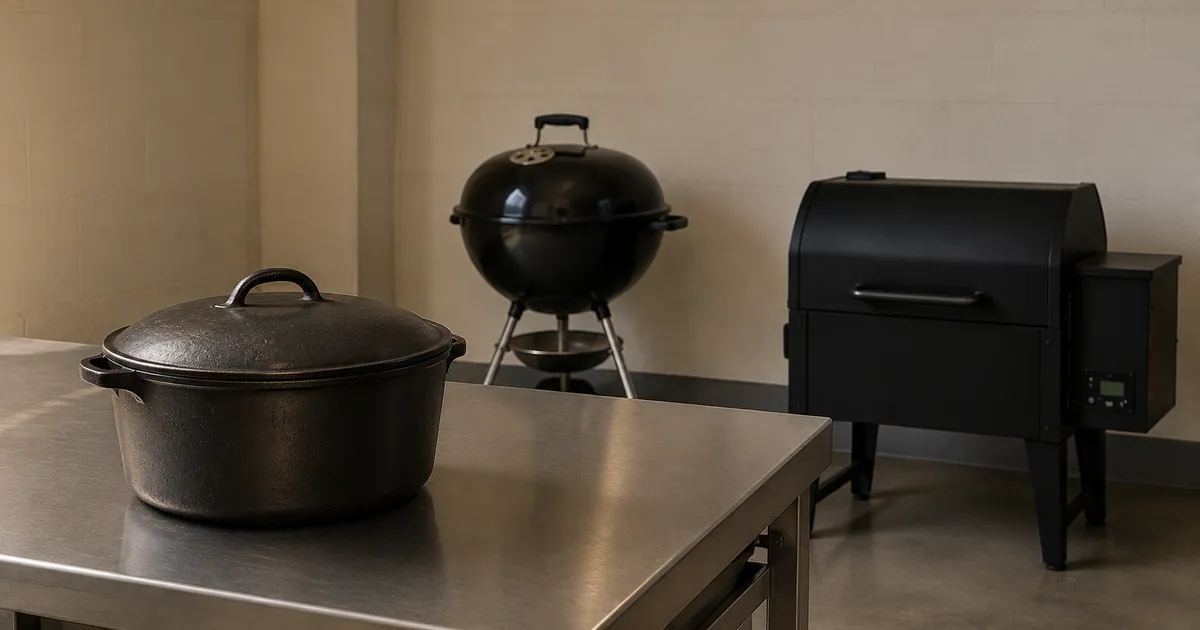
Photo by Southern Foodways Alliance (CC BY 2.0)
Before equipment: the hole in the ground
For most of its history, barbecue needed no gear at all. As the history of barbecue describes, the original American method was a trench dug at the event site, wood burned down to coals inside it, and meat laid across the top. Colonial pit crews carried shovels, not smokers. Above-ground brick and block pits came later, mostly in commercial smokehouses and restaurant yards, and the dug trench still survives wherever a whole-hog crew wants the old result.
Fuel in a bag: the charcoal briquette
The first major change was fuel rather than a cooker. In 1919, Edward G. Kingsford helped Henry Ford arrange a supply of timberland for Ford's auto plants, and the operation's sawmill left mountains of scrap wood. Ford pressed that waste into charcoal briquettes. The product launched under Ford's name and was later renamed Kingsford Charcoal for Edward Kingsford.
The briquette made outdoor fire more predictable. Lump charcoal varies with the wood; a pressed briquette is uniform, stacks neatly, and burns for a long time. That consistency makes it easier to repeat a smoking temperature. Kingsford remains the leading charcoal maker in the United States, converting more than a million tons of wood waste a year.
1952: a buoy becomes the kettle
After World War II, Americans moved to the suburbs and started cooking on patios, but open braziers fought them constantly: ash in the wind, flare-ups, no way to bank heat. George Stephen, who worked at the Weber Brothers Metal Works, studied the rounded shape of a sheet-metal marine buoy and cut it in half. The bottom half held the coals, the top half became a domed lid, and vents controlled the airflow. His kettle, dated to around 1952 in the company's own telling and placed at 1951 by the Smithsonian, could grill in weather and even indirect-cook with the lid on.
The Weber-Stephen company formed in 1958 to build them, and the kettle became the default charcoal grill of the American backyard. Its real innovation was conceptual: it treated outdoor cooking as an airflow problem, solvable with vents and a lid, the same way a smoker is.
The early 1960s: gas comes to the patio
Gas grills reached the mass market in the early 1960s, with cast-aluminum rectangular designs doing much of the early work. The records do not support naming one inventor. Gas brought push-button heat with no chimney, ash, or charcoal bag. The flavor tradeoff is covered in charcoal versus gas versus pellet.
1974: the kamado comes home
Ceramic dome cookers have a much longer pedigree than anything else on this list. Japanese mushikamado rice cookers, clay pots with removable domes, dampers, and draft doors, had been used for centuries, and American servicemen stationed in Japan after World War II started bringing them home. Ed Fisher, a former Navy man, opened a small shop called Pachinko House on Clairmont Road in Atlanta in 1974 and began importing and selling them. He cooked chicken wings out front to draw a crowd, and word of mouth did the rest.
The Big Green Egg line Fisher founded is the best-known descendant, and the design's virtues are thermal: thick ceramic walls hold steady temperature for hours on modest fuel, which makes the kamado a natural smoker as well as a grill. It is the oldest idea in this story and one of the newest arrivals in Western backyards.
1985: the thermostat gets a fire
Joe Traeger, whose family ran a heating business in Mt. Angel, Oregon, spent the early 1980s working on automated heat, building pellet-burning furnaces before turning the idea toward the patio. In 1985 he built his first wood-pellet grill: an auger feeds compressed hardwood pellets into a firepot, a fan drives the burn, and a controller dials the temperature like an oven. The family patented the design, filing US4823684A in October 1987, and sold the concept directly to backyard cooks who wanted less hands-on fuel tending.
After the patent expired, dozens of brands entered the pellet-grill market, prices fell, and controller quality became a key difference between models. Offset versus pellet for brisket compares automatic control with tending a live fire.
Equipment timeline
| Era | Development | Problem it solved |
|---|---|---|
| Colonial era | Earthen trench pits | Feeding a crowd outdoors at all |
| 1919 onward | Charcoal briquettes (Ford, then Kingsford) | Uniform, storable, repeatable fuel |
| Around 1952 | Weber kettle (George Stephen) | Lid-controlled airflow; grilling in wind and rain |
| Early 1960s | Mass-market gas grills | Instant, low-effort heat |
| 1974 | Kamado revival (Ed Fisher, Atlanta) | Long, steady burns on little fuel |
| 1985 | First pellet grill (Joe Traeger) | Thermostatic control; less fuel tending |
| Today | Wi-Fi controllers, leave-in probes | Remote temperature monitoring |
What did not change
Strip the timeline down and every device on it is a box that holds heat above a fire, with some control over air in and air out. The colonial trench had all three parts. Some skills still apply: checking temperature, managing the stall, and resting the meat. If you are picking equipment today, the comparisons are less about history than about how much attention you want to pay, and the guides on charcoal versus gas versus pellet smokers and instant-read versus leave-in thermometers cover that decision directly.
Where this history comes from
- National Museum of American History: Weber kettle charcoal grill
- Smithsonian Magazine: the story of the Weber grill begins with a buoy
- The Henry Ford: Ford Charcoal Briquets
- Atlanta Magazine: how the Big Green Egg became a phenomenon
- Google Patents: US4823684A, pellet-fired barbecue
- Statesman Journal: the Joe Traeger timeline
Common questions about smoker and grill history
Who invented the Weber kettle grill?
George Stephen, a metalworker at Weber Brothers Metal Works, cut a sheet-metal marine buoy in half around 1952: coals in the bottom, domed lid on top, vents for airflow. The Smithsonian dates his first kettle to 1951. Weber-Stephen formed in 1958 to build them.
When was the first pellet grill made?
Joe Traeger built the first wood-pellet grill in 1985 in Mt. Angel, Oregon, after years of building pellet-burning heating equipment. The family filed its patent, US4823684A, in October 1987. That patent has expired, so dozens of brands now make pellet grills.
Why did charcoal briquettes matter so much?
Uniform fuel makes repeatable temperature possible. Henry Ford pressed sawmill waste into briquettes starting in the early 1920s, and the product was later renamed Kingsford. A briquette burns more predictably than raw wood, which makes steady smoking easier.
Where did the Big Green Egg come from?
Japanese mushikamado rice cookers, clay domes with dampers and draft doors, inspired it. American servicemen brought cookers home after World War II, and Ed Fisher began selling them from his Pachinko House shop in Atlanta in 1974, founding the Big Green Egg line.
Related guides
Charcoal vs Gas vs Pellet vs Electric Smokers: Which Should You Buy?
Charcoal and offset give traditional flavor but need attention. Pellet grills hold steady with less tending. Choose based on how much fire-tending you want.
Read the guideOffset Smoker vs Pellet Grill: Which Is Better for Brisket?
An offset needs regular wood feeding for brisket. A pellet grill feeds fuel automatically, reducing manual tending but not replacing supervision.
Read the guideInstant-Read vs Leave-In Thermometer: Which One Do You Need?
An instant-read thermometer checks several spots. A leave-in probe adds live readings and alarms; temperature history needs a model that records it.
Read the guideHow to Control Smoker Temperature: Fire and Airflow
Control charcoal temperature with intake airflow, manage offset heat with fuel and fire size, and let thermostatic cookers regulate themselves.
Read the guide