
SCIENCE · COLLAGEN AND GELATIN
What Collagen Does During a Long Cook
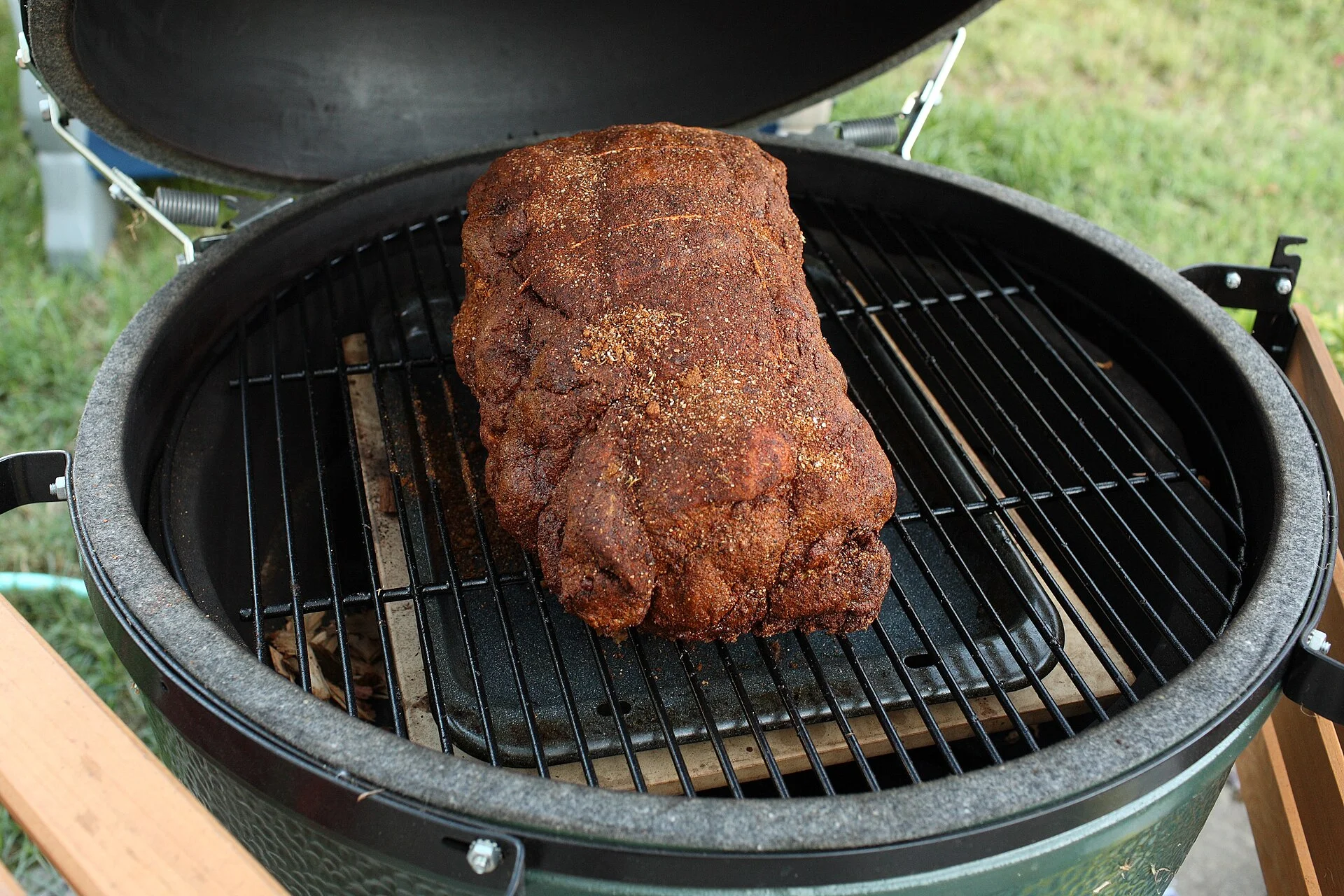
Photo by Thogru (CC BY-SA 3.0), cropped and resized.
Two briskets can both read 200°F and still have different textures. Temperature does not show how far the collagen-to-gelatin conversion has progressed, so the probe test matters too.
The protein that makes tough cuts tough
Collagen is a structural protein found around muscle fibers, between muscles, and in tendons. Hard-working muscles such as the chest, shoulder, and legs contain more of it. Raw collagen is rubbery; long cooking converts it into gelatin.
Heat, water, and time convert it to gelatin
With enough heat and moisture, the tightly wound collagen molecules unwind and hydrolyze into gelatin, the same substance that sets a pan of braising liquid in the fridge. The process gets going meaningfully somewhere around 160°F internal and speeds up sharply as the interior climbs through the 180 to 205°F range. But the reaction is slow by nature. It runs on hours at temperature, not on touching a number.
Gelatin holds water and coats the muscle fibers, giving properly cooked brisket its moist texture and easy bend. A cut that was chewy at 185°F can soften near 203°F as more collagen converts, even if its total moisture has not increased.
Why a 200°F brisket can still be tough
A thermometer reports only the current temperature. Two briskets at the same 200°F can sit at very different points in the conversion, because collagen chemistry varies animal to animal with age and genetics, and because time at temperature differs even when the endpoint matches. The brisket doneness guide treats 203°F as a checkpoint rather than a verdict, and says to trust the probe: when a skewer slides into the flat with almost no resistance, the conversion has gone far enough, whatever the display says.
The probe test measures the texture directly. When a probe slides in with little resistance, the interior has softened enough; the temperature is only a signal to start checking.
Why pork shoulder shreds and brisket slices
Pork shoulder and brisket flat both finish around 205°F, yet one falls into strands and the other is sliced. The difference is architecture. Shoulder is several overlapping muscle groups laced with fat, so once its collagen converts, the whole structure loses cohesion and pulls apart in bundles; the pulled pork guide puts that at about 205°F to shred, or nearer 200°F if you want to slice it. The brisket flat is a single strap muscle with long parallel fibers, so even after enough collagen has converted, it holds its shape and yields to the knife, sliced across the grain.
Fat plays its own part in that texture, which the guide to how fat renders covers separately.
There is a second tissue involved too. Muscle fibers and connective tissue fail differently: past roughly 205 to 210°F in a lean section, the fibers themselves squeeze dry and turn chalky even though the collagen has fully converted. Overcooked pulled pork is not a collagen failure. It is fiber failure on top of a finished conversion.
Conversion targets by cut
| Cut | Interior target | What finished conversion feels like |
|---|---|---|
| Beef brisket flat | ~203°F, probe-tender | Slice bends before it breaks; probe slides like into butter |
| Pork butt / shoulder | ~205°F to shred | Bundles pull free with a fork; bone lifts out clean |
| Ribs | Bend test, toothpick-tender (~198°F) | Meat pulls from the bone but does not fall off |
| Chuck roast | ~202°F, probe-tender | Shreds or slices like a small brisket |
| Chicken thighs and legs | 175°F or beyond | Silky rather than rubbery; leg joints move freely |
Notice the pattern: every one of these targets sits far above the safety minimums, because these cuts are being cooked for texture, not for safety. A 145°F beef or pork minimum with a three-minute rest was passed hours ago. The extra hours are all collagen work.
Lamb shoulder follows the same pattern. Its 195 to 203°F finish is a texture call made hours after the safety line was crossed, and the smoked lamb shoulder guide works that cook through end to end.
Gelatin does not un-cook
The conversion only runs one way. Chill a pot of well-cooked barbecue juices and they set to jelly, which is gelatin proving it is there; warm it gently and it liquefies again. That reversibility is why leftover brisket and pulled pork reheat so well when done slowly with a splash of liquid: you are remelting the gelatin that holds them together. Reheat refrigerated leftovers to 165°F, measured with a thermometer, as USDA recommends. The resting and holding guide covers the serving-day side of the same chemistry.
Cook the cut until it feels tender rather than stopping at a fixed time. A reliable leave-in thermometer shows when the meat enters the target range, and a probe check confirms the texture.
Common collagen and tenderness questions
At what temperature does collagen break down?
Conversion begins measurably around 160°F internal and runs fastest between roughly 180 and 205°F. Time at temperature matters as much as the number itself, so low-and-slow cooks give better results than short hot ones on tough cuts.
My brisket hit 203°F but is still tough. Why?
It may need more time for the collagen to convert. During an uninterrupted cook, keep cooking it wrapped and recheck probe tenderness; some briskets need 205 to 210°F. Once tender, remove it from cooking heat and keep it at or above 140°F during a monitored hold. If cooking stopped or its history is uncertain, do not serve it; use a backup meal.
Can pulled pork be tender below 205°F?
Yes. Around 200°F it can be sliceable, and some shoulders pull apart a little below 205°F. Judge by probe feel and how the bone releases, and treat the number as a checkpoint.
Does marinating tenderize collagen?
Not much, in realistic timeframes. Acids and enzymes act mostly on the surface. Marinades season; heat over hours is what converts collagen. There is no shortcut that replaces the long cook.
Why did my barbecue juices turn to jelly in the fridge?
That jelly is gelatin, converted from collagen during the cook. It is a good sign: it means the conversion ran far. Gentle heat melts it back into the meat as it reheats.
Sources and safety guidance
The sources below cover food safety. Cooking times and tenderness targets are practical barbecue guidance; check the meat as it cooks.
- Safe Minimum Internal Temperature ChartUSDA Food Safety and Inspection ServiceMinimum safe internal temperatures: 145°F plus a 3-minute rest for whole beef, pork, and lamb; 145°F for seafood; 165°F for poultry; and label-specific ham cooking and reheating targets.
- Danger Zone (40°F to 140°F)USDA Food Safety and Inspection ServiceHot food held for later service stays at 140°F or above; food left between 40°F and 140°F is limited to 2 hours total, or 1 hour above 90°F ambient.
- Leftovers and Food SafetyUSDA Food Safety and Inspection ServiceRefrigerate leftovers within 2 hours of cooking, or 1 hour when the temperature is above 90°F, at 40°F or below. For large roasts, cut or slice into smaller parts and use shallow containers for rapid cooling; hot food can go directly into the refrigerator; use within 3 to 4 days and reheat to 165°F.
Related guides
Brisket Internal Temp: When Is Brisket Done?
Brisket is done around 203°F internal in the flat, when a probe slides in like butter. Point vs flat temps, the 160°F stall, wrapping, and a 225 to 250°F pit.
Read the guidePork Butt Finish Temp: When Is Pulled Pork Done?
The pork butt finish temp for pulled pork is about 205°F. Learn the pit temperature, probe and bone tests, stall, timing, and rest.
Read the guideChuck Roast: The "Poor Man’s Brisket" Temp and Timing Guide
Chuck roast picks up brisket-like flavor at a fraction of the size and price. Smoke at 225 to 250°F to 205°F to shred or 200°F to slice.
Read the guideThe Meat Stall Explained: Why Smoked Meat Stops Rising in Temperature
The stall is when a brisket or pork butt parks at the same temperature for hours. Why it happens, how long it lasts, and the three ways through it.
Read the guideHow Long to Smoke a Brisket: Per-Pound Times That Add Up
Plan about 75 minutes per pound at 225 to 250°F: a 12 lb packer runs about 15 hours. Per-pound times, why small flats break the rule, and when to start.
Read the guide